

Your first psychiatric evaluation is a conversation about your symptoms, health history, and how daily life has been affected. You don’t need a diagnosis, medical vocabulary, or a prepared speech before you arrive.
It’s normal to feel nervous. Saying “I’m having trouble explaining this” gives your clinician a place to start. During an initial evaluation at Sagebrush Psychiatry, you’ll have time to ask questions and talk through the reasons behind treatment recommendations.
How to prepare for your first psychiatric evaluation
Complete your intake forms beforehand to leave more time for your concerns. Ask the practice about any required records when scheduling.
The National Institute of Mental Health recommends listing your medications and questions before your visit. Use this checklist to organize what you have.
| What to prepare | Details to include |
|---|---|
| Medication list | Prescriptions, doses, supplements, nonprescription medicines, and allergies |
| Previous treatments | Past medications, therapy, hospital stays, benefits, and side effects |
| Relevant records | Previous evaluations, discharge summaries, and recent laboratory results |
| Main concerns | What feels hardest right now and what you want help changing |
| Appointment questions | Concerns about treatment, costs, follow-up, or privacy |
For a virtual appointment, choose a private space and test your connection. Let the practice know which state you’ll be in during the visit so they can confirm your provider can see you there.
What questions does a psychiatrist ask on the first visit?

Expect questions about your symptoms and history, including previous care, physical health, family history, and safety. Your clinician looks for patterns across these areas.
Your symptoms and daily functioning
Your provider asks about mood, worry, sleep, energy, appetite, concentration, and behavior, including when changes began and how they affect daily life.
Questions can also cover unusually high energy, needing much less sleep than usual, or hearing things others don’t. These experiences help your clinician assess possible causes.
Your medical, treatment, and family history
Your clinician reviews physical conditions, past diagnoses, medications, and responses to earlier care. Family history adds context to the symptoms you’re describing.
If you’re transferring care to Sagebrush, we may ask for permission to request records from your previous prescriber.
Your stressors, substance use, and safety
Questions can cover loss, relationship strain, trauma, alcohol, cannabis, and other substances. Your provider may also ask about self-harm or suicidal thoughts to understand your safety needs. You can ask about confidentiality, request a pause, or explain that a topic is difficult to discuss.
How your provider assesses mood, thinking, and attention

As you talk, your provider pays attention to your mood, speech, and how you organize your thoughts. This part of the visit is called a mental status examination. It may include brief tasks to check attention or memory.
Your clinician may also use a questionnaire to look more closely at a concern. Results from a mental health screening can flag symptoms for further assessment. Your provider uses the broader evaluation to make a diagnosis.
Tell your provider about hearing difficulties, language needs, poor sleep, or anything else that affects your participation. These details help your provider interpret the visit accurately.
What to say at your first psychiatrist appointment
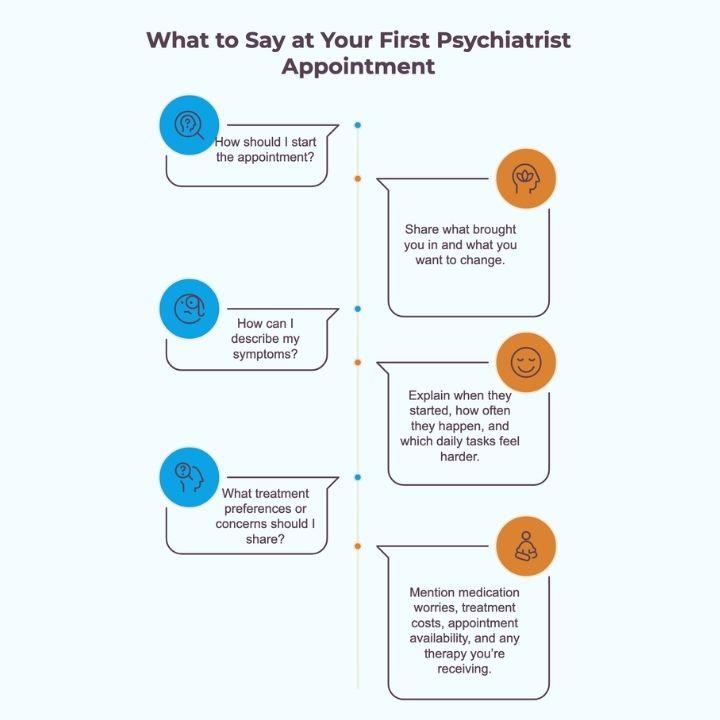
Start with the concern that brought you in and what you want to change. You don’t need to tell your story in order. Your clinician can ask follow-up questions and help you organize the details.
Describe symptom patterns with specific examples
Use everyday examples, even when you have a condition in mind. “I reread the same email several times and still miss instructions” describes a concentration problem more clearly than “My focus is bad.” Add when it happens, how long it lasts, and what makes it better or worse.
Share your treatment preferences and concerns
Mention concerns about side effects, cost, or fitting treatment into your schedule. For example, “I want help with anxiety, but I’m worried about feeling sleepy at work.” If you’re already in therapy, tell your provider.
How your evaluation shapes your treatment plan

Your evaluation helps your provider decide what needs attention first and which options fit your health history and preferences. Recommendations can include medication, psychotherapy, further assessment, medical testing, or coordination with another clinician.
If your provider recommends medication, they can explain its purpose, potential benefits, possible side effects, and alternatives. Ongoing medication management includes follow-up visits to check your response and consider adjustments.
Before you leave, ask your provider these questions.
- What are we treating, and what remains uncertain?
- What changes should I track?
- Who should I contact with questions or side effects?
- What’s my next step?
If you start medication, ask how often you’ll meet with your prescriber.
Start psychiatric care with Sagebrush Psychiatry
We take time to review your concerns, explain your options, and build a plan that fits your needs.
Visit our Reno office at 3675 Lakeside Dr., Suite B, Reno, NV 89509. We also offer telehealth in Nevada, Alaska, and Arizona, depending on provider licensing and availability.
Get a free 20-minute consultation to ask about scheduling an evaluation, or call (775) 410-0189.
Frequently asked questions about your first psychiatric evaluation
How long does a first psychiatric evaluation take?
The length varies by provider and by how much history there is to review. Ask us how much time to set aside when you schedule.
Is a psychiatric evaluation a test you have to pass?
No. It’s a clinical conversation. If a detail is hard to recall, “I don’t remember” or “I’m not sure” is a useful answer.
Will I receive a diagnosis at the first appointment?
You may receive a diagnosis at the first visit or a preliminary diagnosis that needs further assessment. Additional records, symptom tracking, or testing can help resolve remaining questions. Ask what supports your clinician’s impression and what information they still need.
Will I be prescribed medication at the first visit?
You may be prescribed medication at the first visit. The decision depends on your assessment, medical history, preferences, and prescribing requirements. Your provider may recommend gathering more information or considering other treatment options first.
Can I bring someone to my psychiatric evaluation?
Ask us before the visit if you’d like to bring someone. They can provide support, take notes, or describe changes they’ve noticed. You can also ask to speak with your provider alone for part of the visit.